
Stories from our CoP: Gram Disha Trust
Q. Tarun, what first drew you to volunteering with Gram Disha Trust, and how did you get involved in developing IoT and Agri-tech tools for farmers?
My journey with Gram Disha Trust began as I was looking for an organization that could leverage my technical skills primarily in IoT and automation, to contribute to societal well-being. Himachal Pradesh, as an agrarian state, is significantly impacted by climate change, particularly in its agricultural sector. Gram Disha Trust, a charitable public organization dedicated to promoting agroecology, with a focus on Himalayan smallholders, aligned perfectly well with my objectives.
As an intern and volunteer, my role is to contribute to the development of IoT and Agri-tech solutions. I am part of the team working to ensure that the technology we create is affordable, practical, and well-suited to the specific conditions of mountain farms and smallholders in Himachal Pradesh specifically and the Himalayas at large.
Q. What has been the most surprising insight you have learned from interacting with smallholder farmers about technology adoption and how does their perspective align with or challenge agroecological principles?
The most surprising insight that I have gained through our primary field surveys is that the farmers are very much interested in technological solutions provided that the solution helps them stabilize or increase crop yield and also gives them timely insights about pests and diseases. I used to believe that farmers were not very interested in adopting new technology,but my assumption was completely wrong.
Farmers in the Himalayan region are frontline witnesses to climate change, eager to contribute to solutions. Through our field surveys I have also learned that technology is most effective when it complements, rather than replaces this existing wisdom. So, the goal here is not just to provide information but to integrate it with existing practices, thus helping with better decision making. These solutions are intended not just for smallholders but also for policymakers for wider adoption of such solutions as Digital Public Infrastructure (DPI)[3].
Q. What prompted your initial assumption that farmers were reluctant to adopt new technology? Was it based on earlier experiences, prevailing narratives in research, or the perceived challenges of affordability?
My assumption was influenced by the general narrative. Farmers are frequently portrayed as being resistant to adopting modern technologies due to age-old traditions, lack of awareness, or limited exposure. On top of this, the low visibility of technology adoption in rural areas influenced my perception. When I looked around, there were very few examples of advanced tools being widely used, which made it easy to believe that hesitation was the main reason behind it. However, direct field engagement painted a very different picture. Farmers showed great willingness to embrace solutions once they were confident these tools would directly help them stabilize yields or manage risks. The lesson was that assumptions can be misleading, and only ground-level interaction reveals the actual truth.
Q. Agroecology emphasizes blending scientific and local knowledge. How can combining traditional farming wisdom with smart sensor data transform the way smallholder farmers in mountain regions cultivate their land?
Traditional farming is characterized by resilience and self-reliance of the farmers. Going forward technology provides opportunities, but it comes at costs and complexities. A key aspect of traditional knowledge is the historical data based on real production experience of the farmers. This is valuable data for processing. The combination of traditional farming wisdom with smart sensor data creates a scenario for farming, as farmers know the history of their land and its subtle variations.
Smart sensor data provides precise real-time data on soil moisture, microclimate variations, etc. One of the useful aspects for farmers is for those whose landholding is at a distance from their habitats. Technology may also provide support in these cases as well to manage aspects of their production remotely.Blending traditional knowledge with technology leads to optimized resource management, improved crop resilience, and more sustainable farming outcomes in challenging mountain environments.
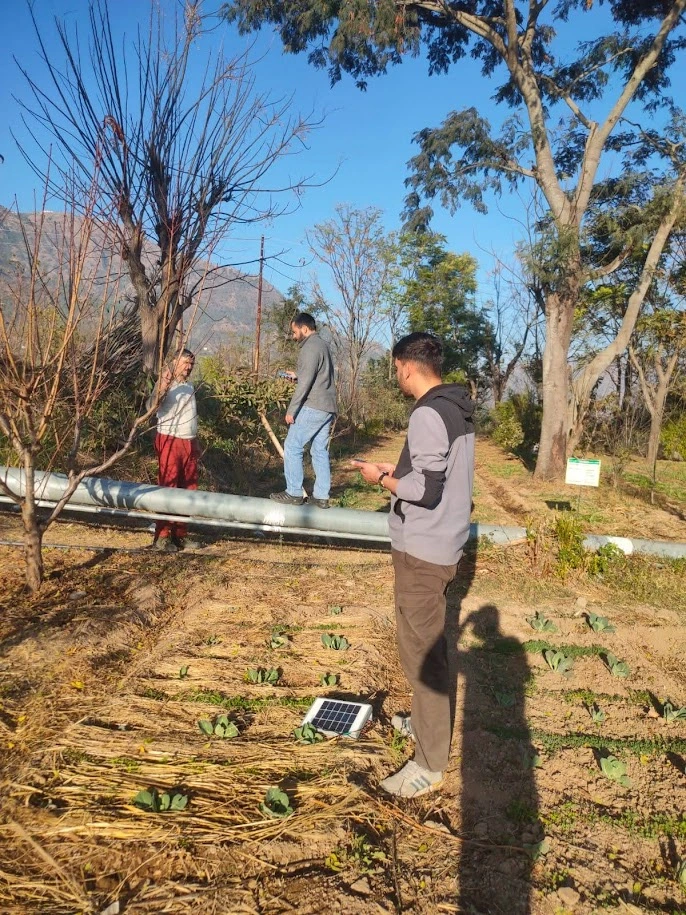
Q. Looking at the SmartSprout project and beyond, how do you perceive student-led or experimental projects can contribute to creating scalable IoT and Agritech solutions that strengthen agroecological practices rather than replace them?
Student-led and experimental projects serve as essential innovation hubs. They can operate with an agility that larger organizations often can't, allowing for rapid cycles of design, testing, and learning. They also provide a blueprint for a more sophisticated or complex solution, whether in IoT or agritech. One key aspect is that such projects lay threadbare the challenges and complexities of developing such solutions. More so, they also help build a real world understanding of the complexity of such deployments for small farmers. Most of the time, this information is hidden within layers of technological success stories which companies do not share in the public domain.
Student-led projects help by forcing practical constraints early, be it in terms of resource limits, rapid prototyping or real-world validation. These projects are often lightweight, modular, open, and validated, which is crucial for creating scalable solutions in agritech, IoT or any other similar domain.
Q. Gram Disha Trust is preparing to launch a project that goes beyond IoT by integrating AI-driven agroecological advisories and sustainable land management solutions. Could you share more about this initiative, the potential risks involved, and how it will help smallholder farmers make more informed decisions?
Gram Disha Trust has created a maxim for appropriateness of technology for smallholders -
“If the technology decreases the operational (input) cost and complexity of the smallholder – consider it – else send it back to the drawing board”
– Gram Disha Trust Agritech Maxim
Q. “Arthur C. Clarke’s 3rd law states that ‘any sufficiently advanced technology is indistinguishable from magic.’ How can you ensure these AI solutions remain relatable and practical for farmers rather than feeling like ‘magic’?
Gram Disha Trust also views Clarke’s 2nd law as perspective which states - ‘The only way of discovering the limits of the possible is to venture a little way past them into the impossible.’ Despite limitations in resources, Gram Disha Trust endeavours to take small but significant steps to innovate and explore domains which are otherwise bereft for smallholders. At Gram Disha Trust, this is always done with a ‘Systems’ approach, where not just the technology but its eventual use case, deployment and even ‘End of Life’ is taken into consideration for a holistic solution.
This is, however, the risk with any advanced technologies be it in farming or any other field. To prevent this in farming, the system must always present outputs in a form that aligns with farmers’ everyday decision-making. Instead of raw data, insights should be communicated as clear actions—such as when to irrigate, when to expect pest outbreaks, agroecological alternatives as the first line of defence etc. If the advice aligns with what farmers already observe, they will see it as an extension of their own knowledge rather than something foreign.
This is where our Maxim (stated earlier) comes in. We apply the rigour of the maxim and ensure that the solutions are real and effective for smallholders. The maxim itself is an evolution from the original Gandhian Talisman where it is important to consider the last person in society before proposing solutions. Thus, in a sense, our steps may be considered as Digital Swaraj.
Digital literacy and training will also be critical in this process. By helping smallholders understand not just the outcome but also the reasoning behind the recommendation we can build trust among them. When AI recommendations are similar to that of traditional practices, farmers are more likely to embrace them as tools that strengthen their wisdom rather than replace it. This grounding keeps technology practical and relatable.
Q. How do you imagine the future of farming in Himachal Pradesh if affordable, farmer-friendly IoT and Agritech tools rooted in agroecology become widely available? What would that mean for smallholders?
If affordable, farmer-friendly IoT and Agritech tools, rooted in agroecology, become widely available, smallholder farmers could make much more informed decisions regarding their crops. This would reduce uncertainty and risks associated with climate variability, provide early warnings to predict and prevent pest and disease outbreaks, and optimize resources, ultimately increasing profitability and overall crop yield. An important aspect is that there is a basic requirement for underlying Digital Public Infrastructure (DPI) on the basis of which all technological solutions are designed.
This is also important to have state owned/regulated data and infrastructure available in the public domain. This will address any commercial or technological bias that private companies tend to have. This also allows for rights and privacy of the farmers also to be protected. Once such a system is in place numerous innovations are possible going forth. The adoption of these tools would also support agroecological practices, leading to healthier soil, better water conservation, and increased biodiversity on their farms. I imagine a future where technology compliments traditional knowledge to create a more prosperous livelihood for farmers.
Q. You have painted a compelling vision where affordable, agroecology-rooted IoT and AgriTech tools not only improve yields but also safeguard farmer rights through Digital Public Infrastructure (DPI). In your opinion, what role should government and public institutions play in ensuring that this DPI is developed and maintained in a way that truly serves smallholders?
Smallholders produce most of the world's food, however, their production system is at risk due to climate change and on the other hand, markets are generally unfair in returns. Thus, they are at double-ended risks. Agri-tech and especially AI is probabilistic at best and unreliable at worst. Besides, the costs of technology keep going up with time. It is grossly unfair if the unreliability of technology should be at the risk of smallholders. This is also in keeping with the Agri-tech maxim of Gram Disha Trust. However, going forward technology is becoming an irreplaceable aspect of Human Life. In systems design, the commercial and bias aspects of deployment are inherent to technology since it never exists in isolation but wears a thin veneer of finance and corporatization. So, what could be appropriate for smallholders?
Important systems aspects for consideration of technology are - public custodianship for answerability, common interface (else there are too many diverse implementations with no clear comparison on technology for smallholders), success of other DPI in India - are a few considerations.
Government and public institutions should build and maintain DPI because only they can ensure fairness. If private companies control it fully, there is a risk of high costs and bias. Public systems can keep data and tools open and accessible, and the government provides a safeguard that prioritizes farmers’ rights and long-term sustainability. This is essential for building trust among smallholders.
They also need to support farmers with training and simple services. When institutions focus on both the technology and the people using it, DPI becomes a support system that could be shaped and trusted by farmers.
Q. What message would you share with innovators and policymakers who want to make Agri-tech truly work for smallholders while also advancing the principles of agroecology and sustainability?
My message to innovators and policymakers who want to make Agri-Tech truly work for smallholders is simple: “Always begin with the farmers, understand their grassroots problems”.
I believe that innovators and policymakers should spend time in the field with farmers, this could help understand the challenges first hand. This way it will be much more effective to create tools or policies which will help smallholders. It is also to be kept in mind that the solutions are designed to promote long-term ecological health and sustainability. Policymakers should increase the funding to recognize grassroot problems and also invest in digital literacy for farmers, this could in turn support farmers adopt such technology.
Q. That is a powerful message!"Always begin with farmers, understand their grassroots problems" In your view, what practical steps or platforms can ensure that farmers' voices remain central in shaping both Agri-Tech innovations and supportive policies?
To understand what farmers think, we need to use clear, organized methods that involve them directly. This could be achieved by involving farmers from the beginning. Platforms like cooperatives, farmer groups, and local forums can give them a place to share their views. Pilot projects must include feedback systems where farmers' suggestions directly guide tool development. At Gram Disha Trust we also have our farm and training center where we undertake trials of production, value chains and technology. In short - all failures of experiments are with Gram Disha Trust and success, if any, are spread out to the smallholders.
Thus this allows us a unique position to conduct field trials for technology before deployment. It also lays, threadbare, the challenges and limitations (cost and complexity) of each such intervention. We take all these results to the public domain to inform the policy and systems design better. In a way, we are the smallholder farmers who first test the technology for viability before promoting it.In addition, platforms that connect policymakers, innovators, and farmers in real time can bridge the gap between design and ground realities. I believe that when farmers see their voices reflected in decisions, they feel ownership of the solutions. This makes technology more practical and closer to real needs.
Q. Finally, as you join the Agroecology TPP community of practice, what do you hope to gain and contribute through this platform?
I look forward to joining the Agroecology TPP Community of Practice. I hope to gain new perspectives on scaling agroecological solutions, I am also eager to connect with a wide range of experts within the community.I hope to contribute by sharing our on-ground experiences from Himachal Pradesh. I believe our work in developing affordable Agri-tech for smallholders can serve as a valuable case study, and I look forward to collaborating with the community to find effective solutions together.
[1] Gram Disha Trust is a non-profit organization based in India that works to strengthen digital public infrastructure (DPI) and promote inclusive, people-centered development, particularly in rural and underserved communities
[2] Internet of Things (IoT) refers to a network of physical devices such as sensors, appliances, and vehicles that are connected to the internet so they can work smarter.
[3] Digital Public Infrastructure (DPI) refers to foundational digital systems that are built in the public interest and enable governments, businesses, and citizens to securely access essential services.
Connect with Gram Disha Trust and Tarun Kumar:
🔗 LinkedIn:
- www.linkedin.com/in/tarunkumar455
- https://www.linkedin.com/in/guptaji/
🔗 Facebook: https://www.facebook.com/gramdishatrust/
🔗 Website: www.gramdisha.org
🔗Link to the photos: Gram Disha - Google Photos
Do you want to share your story? Contact [email protected] to indicate your interest and discuss how your journey could be featured in an upcoming edition.
📰 Explore more: Stories from our CoP